THEY WEIGHED 500 GRAMS
11.09.2026
On one of the walls at Perinatal Centre No. 1 in Esik, there are photographs of children. In the earliest pictures, they are tiny — premature babies whose lives doctors once fought to save. In others, the same children appear years later. Some have already started primary school, some are sitting on their grandparents’ laps, some are posing for keepsake photographs, and some are singing on stage. Among them are boys and girls whose lives began not at home in a cot, but in an intensive care unit.
Perhaps this wall of photographs explains better than any statistics why perinatal centres need modern medical equipment.
Because behind every piece of equipment is someone’s future.
Just a few metres from the photographs, other babies are being cared for today. Some weigh only 400-500 grams at birth. They are so small that it is difficult for an adult even to imagine how fragile a life that has only just begun can be.
For most babies, the first breath is a natural continuation of birth. For a premature baby, it can be the first challenge.
The lungs are not yet ready to function fully, the body cannot regulate its own temperature, and medicines must be administered with a level of precision at which every dose matters. Here, it is not only days and hours that count. Sometimes it is minutes.
And throughout all of this, doctors remain by the baby’s side.
They help the baby breathe. Monitor every vital sign. Keep the baby warm. Feed them. Wait for the tiny body to grow a little stronger. A few more grams. Another stable day. Another step towards the moment when the baby can finally leave intensive care — and, later, go home in the arms of mum and dad.
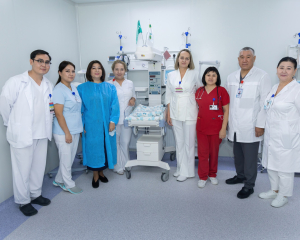
Doctors at Perinatal Centre No. 1 in Esik now have greater capacity to fight for these fragile lives.
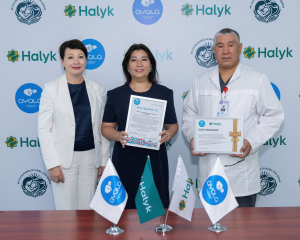
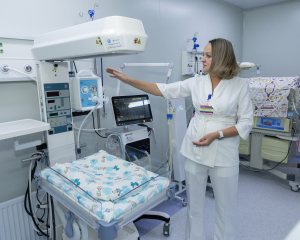
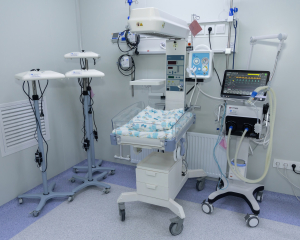
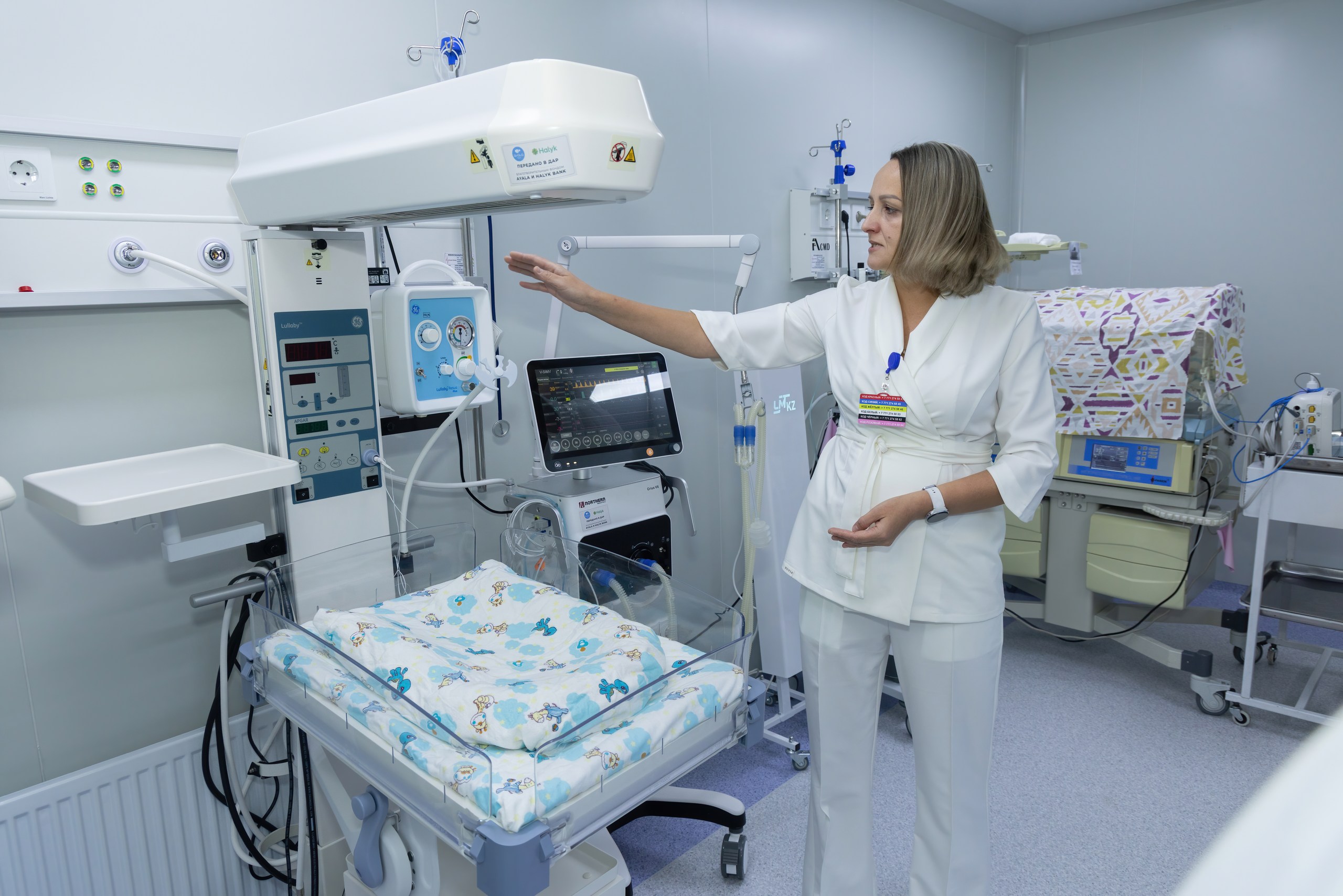
With the support of Halyk Bank, AYALA Charity Foundation has provided the centre with modern neonatal resuscitation and intensive care equipment: a mechanical ventilator, an open neonatal resuscitation system, three phototherapy lamps and two infusion pumps.
Behind these complex medical terms are very simple purposes: helping a baby breathe, maintaining the right body temperature, treating neonatal jaundice and administering life-saving medicines with precision.
Most importantly, the equipment gives doctors the means to support a baby’s fragile body until it becomes strong enough to cope on its own.
“I cried for several days”
For parents, a neonatal intensive care unit is an entirely different world. Instead of the first peaceful days at home with their baby, there is waiting. Instead of a cot beside them, there is medical equipment. Instead of the familiar question, “Who does the baby look like?”, there is only one: “Will my baby live?”
Young mother Oryngul Imangaliyeva has been through this herself. Her baby was born prematurely and weighed just over one kilogram.
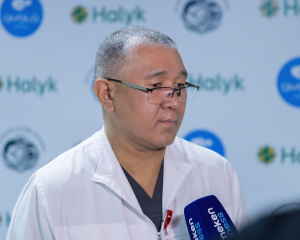
“At first I was terrified. I cried for several days. I didn’t know what to do. Those were frightening moments. But now, thanks to this equipment, I have hope. I can see my baby, see him breathing, moving his little fingers, living. His condition is stable and he is healthy. What could be better for a mother?” she says.
Just a few sentences, behind which lie days of fear and waiting.
Today, her baby is receiving the care he needs, and his mother can already say the words that, for parents in units like this, probably mean more than almost anything else: his condition is stable.
And there are many stories like this here.
According to Dauren Imanaliyev, Director of the Perinatal Centre, 187 premature babies have been born here, 44 of them with very low birth weight. With the help of the donated equipment, 20 babies have already received highly specialised medical care and returned home to their families.
Twenty children.
In a medical report, it is simply a number.
But in real life, it means twenty homes where a baby’s cry can now be heard. Twenty families who were able to take their child home. Twenty mothers who once entered intensive care in fear and later left the hospital with their baby in their arms.
From 500 grams to the first day of school
In February 2026, the maternity unit moved into a new building and was granted the status of Perinatal Centre No. 1 in Esik. Today, it provides specialised care to women and newborns from across the district.
The centre handles around 4,000 births each year. Its neonatal intensive care unit has 14 beds for babies who require continuous monitoring, respiratory support and intensive care immediately after birth.
But there is one detail that reveals what matters most behind all the medical statistics.
That wall of photographs.
It shows former patients of the centre.
Once, doctors watched every breath they took and every gram they gained. Once, their parents were afraid to make plans even a few days ahead.
Today, very different children are smiling from those photographs.
Brothers and sisters, toddlers and schoolchildren.
And perhaps this is the clearest measure of what neonatologists achieve: one day a baby weighs only a few hundred grams; years later, their mother is packing a school bag for them. Reaching that ordinary morning took an extraordinary journey.
Technology behind which are human lives
AYALA Charity Foundation’s Let’s Breathe Life programme has been running for almost two decades. Over that time, 67 healthcare institutions across Kazakhstan have been equipped with modern medical technology.
“Every year, this equipment helps doctors at perinatal centres in Esik and other cities across the country save the lives of hundreds of newborns, including premature babies with low birth weight. Today, together with our partner Halyk Bank, we saw the result of that support here — a child’s life that was saved,” said Natalya Yeskova, Vice President of AYALA Charity Foundation.
Halyk and the Foundation have worked together since 2010. Over that time, the bank has contributed hundreds of millions of tenge to AYALA projects focused on protecting newborn health.
And the results of this long-standing work are measured not only by the number of pieces of equipment purchased.
According to the Foundation, by the end of 2025 Kazakhstan had achieved the lowest neonatal mortality rate among Central Asian countries, while the survival rate of babies with extremely low birth weight had increased fourfold.
“Together with the state, doctors and our partners, we have consistently built and strengthened a modern neonatal care system in Kazakhstan. Today, we can see the remarkable results of this major collective effort. It is especially important to us that Halyk Bank has remained part of these changes for more than 15 years,” said Aidan Suleimenova, Founder and President of AYALA Charity Foundation.
“AYALA Foundation and Halyk are connected by many years of trust and collaboration. We have supported the Foundation almost since its earliest days because we know how responsibly it approaches every project, every decision and, most importantly, every child’s life. Behind all these years are not simply figures and reports, but tens of thousands of children who received timely help and thousands of families for whom that help became a source of hope. For us, this partnership is above all a story of trust, responsibility and a shared conviction that nothing is more precious than a child’s life saved,” said Umut Shayakhmetova, Chairperson of the Management Board of Halyk Bank.
What matters most cannot be measured in numbers
When you look at a modern machine in an intensive care unit, it is easy to see it simply as medical technology: a screen, tubes, sensors, readings.
But look a little further — at the baby beside it.
Today, that baby weighs only a few hundred grams. Their palm is smaller than an adult’s little finger. They do not yet know their own name, their mother’s voice beyond the walls of the unit, or the vast world they were in such a hurry to enter.
For now, their task is much harder.
To breathe.
To gain weight.
To live.
And beside them are people and technology helping them do exactly that, day after day.
Years will pass. Perhaps one day a photograph of this baby will also appear on that wall at the Perinatal Centre. Only in the new picture, they will no longer be lying among wires and sensors.
They will be standing with a school bag on their back.
Or holding their parents’ hands in the park.
Or smiling in a school photograph.
Perhaps they will never remember the doctors who once counted every breath. They will not know the names of the machines that gave their tiny body the time it needed to grow stronger. They will not remember the hospital room where their life began.
And that is the best outcome of all.
Because the child whose life an entire team once fought to save is simply living.